Home › TV Mounting › Miami Beach
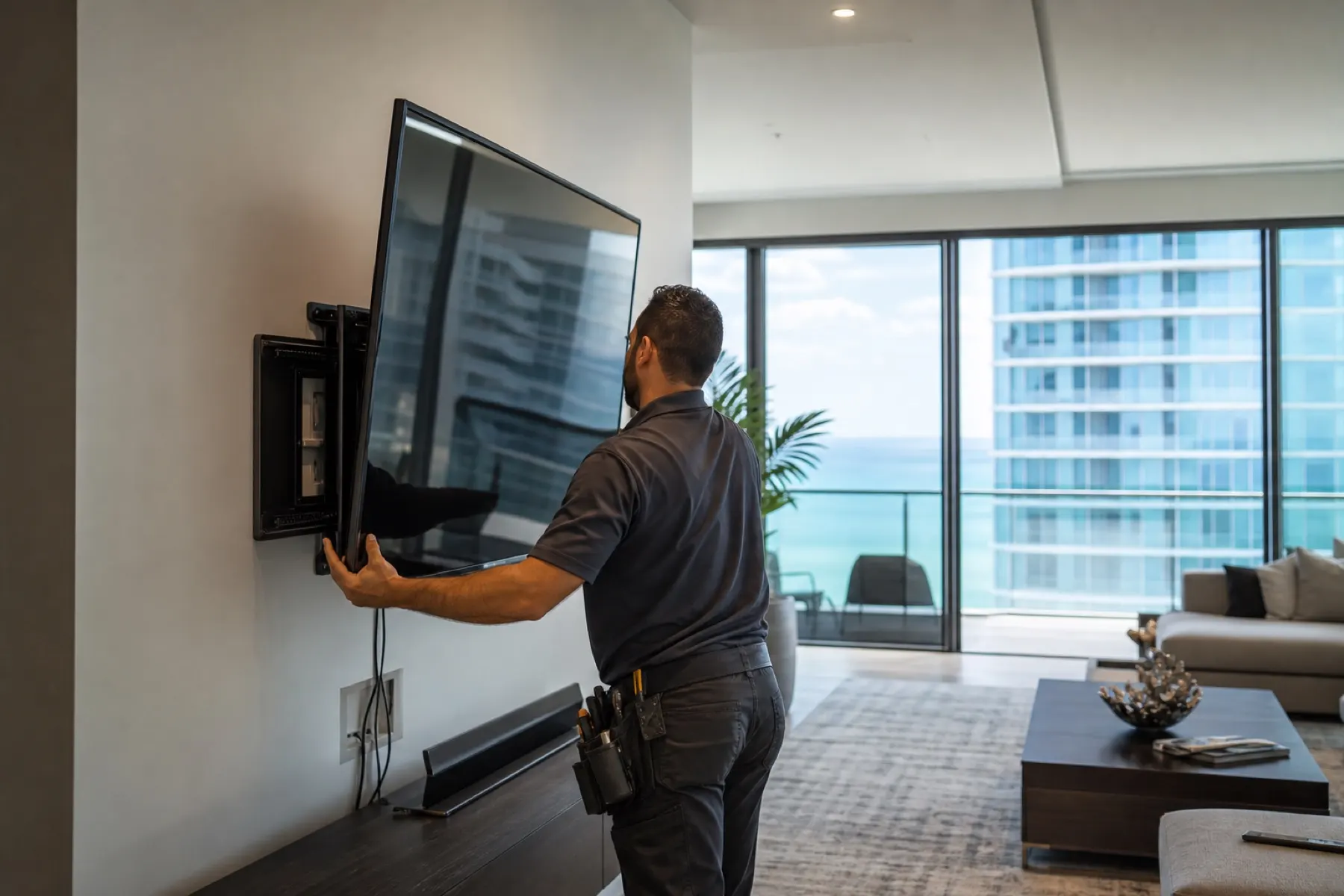
On a barrier island the fireplace is rarely there for warmth, and that changes the whole discussion. In the Art Deco and MiMo buildings of Miami Beach the surround above the hearth is often plaster moulding, a later electric insert, or a decorative opening that has never held a fire — so heat stops being the main constraint and two other things take over. The first is elevation. A mantel or a raised plaster shelf forces the screen up above the height a seated viewer would ever choose, and unless the bracket tilts or drops the picture down, the room looks up at it every evening for years. A pull-down arm solves that properly, and it is heavier and more expensive than a flat plate, so it belongs in the conversation before the hardware is bought. The second is what the surround is fastened to: plaster over hollow tile in a 1930s low-rise behaves nothing like a metal-stud partition in an oceanfront tower. Gold Hands fixes to sound structure, sets height from where you sit, and refers electrical work to a licensed trade.
Measure the shelf, then measure yourself. The distance from the floor to the top of the mantel or surround, the clear wall above it, and — the one that gets skipped — the height of your eyes above the floor when you are settled on the sofa with the lamp on. Those three numbers tell us whether this wall takes a flat plate, a tilt, or an arm that carries the panel down clear of the fireplace and folds away again. With a photograph they usually tell us before anyone visits. Send them to (786) 788-8714. Gold Hands works the length of the island: South Beach and its Deco blocks, the Collins Avenue towers through Mid-Beach and the houses on the bay side, and up into North Beach and the canal streets of Normandy Isles and Normandy Shores. Three ZIP codes, and what sits above the hearth changes completely between them. Our technicians speak English, Spanish and Russian.
A message that reached us from a Normandy Isles house read "Wall mount above fireplace" with a single picture of a 1940s living room, and the picture answered questions the sentence had not asked. The surround was original plaster, painted many times, with a shallow shelf at chest height and a band of sea air coming through the jalousies behind the camera. That last part matters more here than anywhere inland. Plated steel bracket hardware on this island blooms orange inside a season, and a screw that has rusted into a plaster wall does not come out cleanly when the television is replaced in four years — which is why we put stainless fixings into island walls as a matter of course, not as an upgrade. The same request from a Collins Avenue tower is a different job again: a linear insert in a stud partition, a front desk to sign in at, and a building that has opinions about drilling. Concealing the cable run and putting a second screen in the guest room are jobs we do, but they belong to their own pages; here the question is elevation, and what lies behind the plaster.
Call (786) 788-8714 · Get a free quote

Every job gets a free written estimate with the scope, prep and materials named — not a vague day rate. Gold Hands Miami is insured. Work that legally requires a licensed trade is referred to a licensed pro.
Deco surrounds and plaster shelves: the height problem in a Miami Beach low-rise
The 1930s apartment buildings that make South Beach what it is were laid out for furniture, not for screens. Ceilings in many of them are modest, the decorative surround sits high on the wall, and once a mantel shelf takes its cut there is a short, tall band of plaster left over — exactly the shape that produces a television you look up at. Our technician measures the seated sightline before touching the wall, because the gap between where your eyes are and where the screen can physically start is the number the whole visit turns on. When it is small, a tilting head angles the face down and the problem disappears. When it is large, we say so plainly and put the pull-down arm on the table with its real costs attached: more weight, a deeper fixing, a mantel it has to clear on the way past, and a price that is not the same as a flat plate.
There is a wrinkle specific to this island. Many South Beach blocks fall under Miami Beach's historic-preservation oversight, and while nobody reviews the inside of your living room, a great many of these surrounds are original fabric that a building or a board would rather keep intact. Drilling straight through a moulded plaster face is not something we do casually. Where the surround is original and the plaster above it is sound, we fix above or beside the decorative element rather than into it. Where that is impossible without a compromise, the honest recommendation is often the adjacent wall, which in a Deco floor plan is frequently closer to the sofa and at a far kinder height. The fireplace stays the feature it was built to be, and nobody spends the evening with their head tipped back.
Salt air, stud partitions and front desks: mounting in the Miami Beach towers
In the Collins Avenue towers through Mid-Beach and North Beach, the fireplace is a modern insert in a partition built over a concrete shell, and the two structural facts are opposites. The shell will carry anything and is generally off limits. The partition is light metal studwork faced with board, put there to frame a surround rather than to hold a large screen on a swinging arm. Our technician locates the actual studs rather than trusting a magnet reading, checks what depth is available in front of the shell, and drills a pilot before any load-bearing fixing goes in. Where the framing will not honestly take a pull-down mount, we will fit a tilting bracket and explain why, or add proper backing if the building permits it. What we will not do is put an arm on studwork and hope the leverage never finds the weak point.
Access is half of a tower job here. Buildings on the oceanfront run certificates of insurance, service-elevator bookings, approved work hours and a sign-in at the desk, and a crew that turns up without those gets sent home. Send us your management contact with the enquiry and the paperwork goes in ahead of the visit. Then there is the sea itself. Units facing the Atlantic live with salt-laden air whenever a balcony door is open, and it finds bracket hardware quickly — so fixings, washers and the arm's own pivots want stainless or properly plated components, and a screen mounted near a balcony wants its connections checked rather than assumed. Inland that is fussiness. Three hundred feet from the water it is the difference between a mount you forget about and one that seizes.
Normandy Isles and the bay side: single-family fireplace walls in Miami Beach
Away from Collins Avenue, on the canal-lined streets of Normandy Isles and Normandy Shores and on the quieter bay-side blocks, the work looks like an ordinary house again — and the walls are mid-century, which means they need reading. Behind the paint you may find concrete block, hollow clay tile, or a stud wall added when a porch became a den in the 1970s. Each one takes a different anchor and each one gives a different answer when the drill goes in. Our technician does not decide from the outside. He taps, scans, and takes a small pilot hole in a spot the bracket will later cover, then chooses the fixing for what is genuinely there. On solid block a pull-down arm is straightforward. On a 1970s partition it may not be, and that is worth knowing before the box is opened.
These houses also produce the island's most common seating problem: a living room with one wall of glass toward the water and a fireplace on the opposite wall, which puts the sofa at an angle to both. Height is decided from where the family actually sits in the evening, not from the middle of the room or from a tape measure resting on the floor, and in a room like that it is worth sitting down in the chair before agreeing a number. Where our work ends, without euphemism: we select the bracket, we find and use sound structure, we get the panel level and we connect the equipment you already own, including drawing a signal lead through a cavity that is already open. Everything carrying mains voltage belongs to somebody else — power that does not yet exist behind the screen, a circuit that has to be moved, cable buried in plaster — and so does every question that begins with the firebox or the flue. Permitted work in the City of Miami Beach follows that same route, and we say which trade you need rather than stretching to cover it.
Neighborhoods and ZIP codes we cover in Miami Beach
- South Beach, Miami Beach (33139)
- Mid-Beach, Miami Beach (33140)
- North Beach & Normandy Isles (33141)
TV Mounting in Miami Beach — questions we get asked
How is a Miami Beach TV mounting quote worked out, and why is there no price here?
Because the same sentence describes two very different afternoons. A flat plate on a sound block wall and a pull-down arm on a tower partition that needs backing are not the same job and pretending otherwise would mislead you. The free written estimate is assembled from the screen's size and weight, what the wall behind the surround turns out to be, whether your seated height needs a tilt or a drop-down arm, and whether any of it belongs to an electrician. A square-on photo of the fireplace, the mantel height from the floor and your television's model number are usually enough for a written answer with no visit.
Who will be in my Miami Beach apartment, and what protects the floor and the surround?
A named technician from our own crew, who signs in at your desk under his own name rather than a generic company line. Deco floors and terrazzo do not forgive dropped tools, so boards and blankets go down before anything else happens, and original plaster mouldings get masked rather than leaned on. The television stays boxed until the wall plate is fixed and load-tested, and anything over a certain size is lifted by two people. If a set is damaged while it is in our hands, we own it and tell you the same day — that is a far better outcome for both of us than a quiet scratch discovered next week.
My Miami Beach co-op board has to approve alterations. Does mounting a TV count?
Often it does, in the older co-ops and the historically overseen buildings especially, and the way through it is paperwork rather than argument. Boards here are usually protecting two things: original fabric and the structural shell. A bracket on a plain plaster wall above a decorative surround threatens neither, and saying so in writing — with the fixing type and the insurance certificate attached — gets approval far more often than turning up unannounced. Give us the management contact when you write to us. We would rather spend a week waiting for a board than half an hour creating something you are made to undo.
Will the screen sit too high above my Miami Beach fireplace?
In a low-ceilinged Deco room with a tall surround, sometimes it genuinely will, and we would rather lose the booking than pretend otherwise. We measure your eye height from the seat and compare it with the lowest point the screen can reach on that wall. A small difference is absorbed by tilting the head a few degrees. A large one is not, and then the choice is a pull-down arm or another wall. In a handful of these apartments the fireplace wall is simply the wrong home for a television and the better answer is two metres to the left, where the ceiling is the same but your neck is not involved.
I rent in Miami Beach. What happens to the wall when my lease ends?
Ask the owner first and get the yes in writing, because the surfaces here vary more than most. Painted plaster over block fills and touches up so well that nobody finds the fixings afterwards. An original moulded surround is a different matter — a hole in decorative plaster is a restoration job, not a dab of filler, and no landlord on this island is relaxed about that. Tiled or stone facings never fully recover either. Mention the tenancy with the photo, and we will say which of those you have got, so the question you put to your landlord is the accurate one.
Does living on the beach really change how a TV mount is fitted in Miami Beach?
It changes the metal. Salt-laden air moves through an open balcony door and settles on everything, and ordinary plated fasteners corrode here at a speed that surprises people who moved from inland. Rusted fixings are not just ugly: they seize into the wall, so the day you upgrade the television the bracket fights back, and a corroded pivot on a pull-down arm stops moving smoothly long before it stops working. We specify stainless hardware for island jobs by default. It is a small difference on the day and a large one four years later.
How long does TV mounting take?
Most jobs take 45 to 90 minutes depending on wall type and cable concealment. Concrete and brick walls take a bit longer because of drilling.
Do I need to provide the mount bracket?
You can provide your own, or we bring one. We recommend fixed, tilting, or full-motion based on your TV size and where you sit relative to the wall.
Other work we do in Miami Beach
- Ceiling Fan Installation & Repair in Miami Beach
- Door Repair & Installation in Miami Beach
- Drywall Repair in Miami Beach
- Faucet Installation & Repair in Miami Beach
- Furniture Assembly in Miami Beach
- Garbage Disposal Installation & Repair in Miami Beach
- Light Fixture Installation in Miami Beach
- Interior & Exterior Painting in Miami Beach
- Picture & Mirror Hanging in Miami Beach
- Shelf Installation in Miami Beach
- Toilet Installation & Repair in Miami Beach
Need tv mounting in Miami Beach?
Send photographs of the job to (786) 788-8714 and a written quote comes back naming the scope and the materials. The quote costs nothing, and nothing reaches the invoice that was not on it.