Home › Toilet Installation & Repair › Miami
A bidet seat looks like an hour's work and is really three separate questions, and almost everybody only asks the first one. Will it sit on the pan you already own — a round bowl and an elongated bowl are not the same length, and the seat posts have to land on the two holes already drilled through the back of the rim. Where does its water come from — a small tee spliced in at the toilet's fill valve, which happens to be the exact joint that starts weeping when a plastic tee has been cranked down onto a compression fitting that was never built to take that much turn. And does it want electricity — a heated, warm-air, remote-controlled washlet does, and it wants a grounded socket close enough for its own cord, which older bathrooms across Miami simply do not have. Gold Hands fits bidet seats onto existing toilets here: the supply tee, the fill valve, the seat hardware, and a non-electric unit carried from the carton through to the first flush. Gold Hands is not a licensed plumber and does not carry out licensed electrical work, so a new socket beside the bowl, pipework running inside a wall, relocating a drain, or anything the county wants a permit for goes to the licensed trade — and you hear that at the bathroom door, not after the box is open.
Gold Hands works on toilets and bidet seats across the City of Miami and the county pockets stitched into it — Little Havana and Little Havana West, Allapattah and the Health District, Coral Way and Shenandoah, Wynwood, the towers downtown and along the port, and west through Flagami, Westchester, Olympia Heights and Tamiami. Fourteen ZIP codes, and the bathroom behind each address behaves differently. The message that lands in our inbox most often reads almost word for word like this one: we just have a bidet seat we are trying to install and it keeps leaking at the fill valve, we've tightened it. The tightening is the part worth stopping on, because it is usually what is causing the leak rather than failing to cure it. Three things decide how this call goes, so look at them before you dial: the flexible line arriving at the bottom of the tank and the little valve it comes off, whether there is a socket anywhere a short cord could reach the bowl, and how many inches of clear wall sit to the left and right of the seat. With those three answers, a text to (786) 788-8714 gets you a straight reply. Our crews talk it through in English, Spanish or Russian, whichever suits you.
The other half of the inbox is simpler and sadder: I have a bidet that I need installed for 1 toilet, is that something you can help with. Usually yes. Occasionally no, and the reason is almost never the plumbing. It is that the unit sitting in the hallway is an electric washlet, and the bathroom it is destined for was finished in 1952 and has one light switch, one ceiling fixture and no receptacle at all — or one over the basin, on the wrong wall, four feet and a doorway from the bowl. Adding a socket beside a toilet is a licensed electrician's job with a GFCI on the end of it, not a handyman's, and it is far better to learn that before the unit is unboxed and unreturnable than after. A non-electric seat sidesteps the whole question and installs the same afternoon.
Call (786) 788-8714 · Get a free quote

Every job gets a free written estimate with the scope, prep and materials named — not a vague day rate. Gold Hands Miami is insured. Work that legally requires a licensed trade is referred to a licensed pro.
Round or elongated: what a Miami pan will physically take
Two measurements settle this and neither of them is on the box in a useful way. The first is the bowl from the seat bolts to the front rim: roughly sixteen and a half inches is a round pan, roughly eighteen and a half is elongated, and a seat built for one overhangs or underhangs the other badly enough that the lid will not close square. The second is the spread between the two bolt holes at the back of the rim, which has been five and a half inches on standard fixtures for a very long while — but not on everything, and Miami has a lot of everything. In the 1920s and 1930s houses along Coral Way and Shenandoah, and in the bungalows around Calle Ocho, we still find original close-coupled fixtures whose bolt spacing and rim shape predate the convention entirely. On those, a modern bidet seat is not always fittable, and the honest answer is sometimes to leave the fixture alone.
There is a third dimension people forget until the seat is half on. A bidet seat carries its own plate, and that plate sits between the back of the rim and the front of the tank; on a close-coupled fixture with a tank that leans forward, there may be less than an inch there. Side-arm controls need their own clearance too — in the narrow second bathrooms typical of Little Havana walk-ups and the small apartment buildings through Allapattah, a bowl set close to a side wall can leave the control arm pressed against plaster. A remote-operated unit solves that, a lever unit does not. Two photographs — one straight down onto the seat, one from the side with a tape measure across the rim — answer nearly all of it before anybody drives anywhere.
Why the fill valve keeps weeping in Miami bathrooms, and why tightening makes it worse
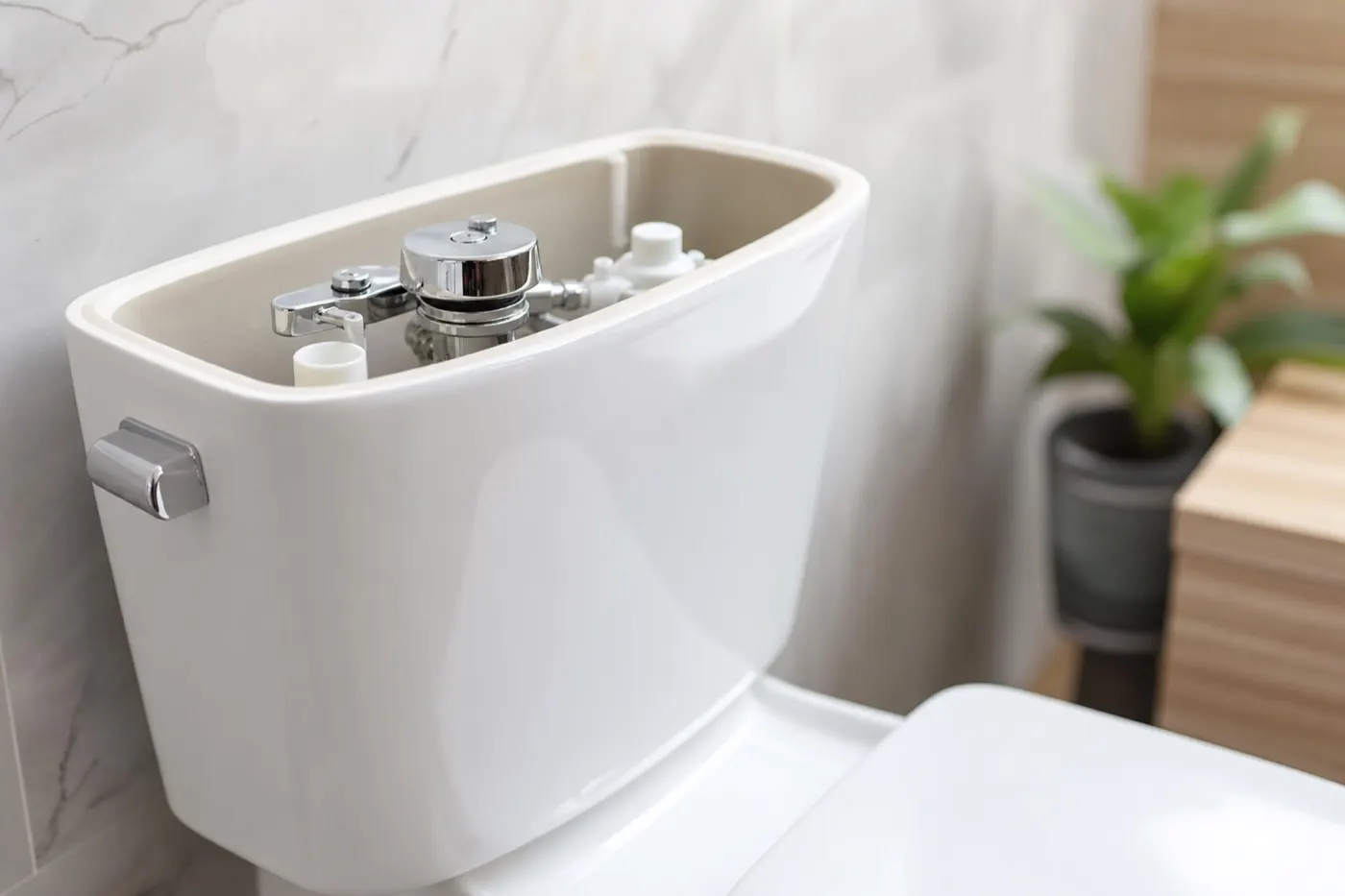
The bidet's hose has to pick up water somewhere, and the place it picks it up is the shank of the fill valve, under the tank, where the flexible supply already arrives. A tee goes on there: the flexible line lands on one side, the bidet hose on another, the fill valve shank on the third. Most kits ship that tee in plastic, with a rubber washer that seats flat and a nut meant to go finger-tight plus a small turn. What people do instead — reasonably, because a drip looks like something that wants a wrench — is keep turning. Plastic threads bed down, the washer squirms off its seat, the flange distorts slightly out of round, and the joint that was seeping a drop an hour starts seeping steadily. Then it gets tightened again.
So the first thing we do on a call like that is take the joint apart rather than add force to it. Nine times out of ten the fix is a washer seated properly, a tee replaced with a brass-bodied one, and a stop valve that is actually closing. That last one matters more in Miami than people expect. In the mid-century concrete-block houses through Westchester, Olympia Heights and Tamiami the angle stop under the toilet is often the original multi-turn valve, and our water has left enough scale in it that it turns, feels shut, and still passes a trickle. Working on a live supply with a valve that will not close is not something we will do — if that stop has failed at the valve body, the job stops there and goes to a licensed plumber, because the alternative is a house with water in it and no way to stop it.
The socket nobody has: electric washlets in older Miami bathrooms
This is the question that actually kills bidet projects in Miami, and it has nothing to do with plumbing. A heated-seat, warm-water, warm-air washlet is an appliance. It plugs in, it wants a grounded receptacle protected by a GFCI, and its cord is short on purpose. The bathrooms in the 1940s to 1960s housing west of the river, in the walk-ups around Calle Ocho and in much of Allapattah were built before a bathroom receptacle was ordinary, and plenty of them still have none. Some have one, added at some point over the basin, which is usually on the far wall and out of reach. Running an extension lead across a bathroom floor to a toilet is not a solution, and we will not set one up for you.
Adding a proper receptacle beside the bowl means a circuit, a box, a GFCI device and an inspection — a licensed electrician's work, and we hand it over rather than improvise. Two honest alternatives exist and we will lay both out. One is a non-electric seat: ambient-temperature water, mechanical controls, no cord, no socket, and it goes on in an afternoon. The other is to get the electrician in first and us in second, which is the right order and costs less than doing it the other way round. Downtown and near the port, in the towers along Biscayne Boulevard, the picture flips — those bathrooms generally do have a receptacle, and the constraint moves to the building instead: the plumbing sits in a shared wall, the stack serves the stack above and below you, and what can be teed at all is a question for management before it is a question for us.
Neighborhoods and ZIP codes we cover in Miami
- Little Havana West (33125)
- Flagami & Airport District (33126)
- Wynwood & Little Haiti South (33127)
- Downtown Miami West (33128)
- Downtown Miami & Port (33132)
- Little Havana (33135)
- Health District & Overtown (33136)
- Allapattah (33142)
- Coral Way & Shenandoah (33145)
- Westchester & Glenvar Heights (33155)
- Olympia Heights & West Westchester (33165)
- Tamiami (33175)
- West Little River (33168)
- Westview (33167)
Toilet Installation & Repair in Miami — questions we get asked
What does fitting a bidet seat in Miami cost, and how do you work the figure out?
You will not find a number on this page, because the same request covers two very different afternoons. The written estimate costs nothing and is built after four things are known: the bowl's shape and bolt spacing, whether the angle stop under it actually closes, whether the tee point at the fill valve is sound or already been over-tightened, and whether the unit needs power that the room does not have. Photographs of the bowl from above, the tank from behind and the wall beside it get you most of that answer by text at (786) 788-8714 without anybody leaving the shop.
Who comes into my Miami bathroom, and what happens to the floor while they work?
One of our own crew, named to you beforehand. A bidet install means a tank drained into a bucket and a supply line opened, so a drop cloth and towels go down before a tool comes out of the bag — the water in a toilet supply is clean, the water under the rim is not, and we treat the floor accordingly. If the unit turns out to need an electrician, you hear it at that moment, the toilet goes back together working as it was, and you are not charged for finishing a job that could not be finished.
I am in a condo tower in Miami. Will the building let a bidet be teed in at all?
Usually yes, and the tee is not really the building's business — it happens entirely inside your unit, downstream of your own stop valve. What is the building's business is the risk. Management along Biscayne Boulevard and around the Government Center will generally want a certificate of insurance on file and service-elevator time booked, and some want notice that water is being worked on at all. Give us the management contact and that paperwork goes ahead of the crew. The one case where the answer changes is a unit whose stop valve has failed: shutting water off then means shutting the riser, and that is management's schedule, not ours.
I already bought a bidet in Miami. Will it actually work in my bathroom?
Send three photographs and we will tell you honestly, including when the answer is no. The fit half is measurable — bowl shape, bolt spread, how much room the mounting plate has in front of the tank, and whether a side control arm clears the wall. The half that catches people out is power: if it is a heated washlet, it needs a grounded socket within its own cord's reach, and a great many Miami bathrooms have nothing on that wall. We cannot add one, because that is a licensed electrician's job with a GFCI on it. What we can do is tell you before the box is opened, while the unit is still returnable.
I rent in Miami. What does my landlord need to agree to first?
Get it in writing before we come. A bidet seat is a reversible change and that works in your favour — the original seat comes off, goes into a bag, and goes back on at the end of the tenancy with nothing to show for it. The tee at the fill valve is the part an owner cares about, because it is a new joint on their water, and most owners are fine once they know a trade did it rather than a housemate. Two things genuinely need a yes: anything involving a new receptacle, which is the owner's electrician and the owner's decision, and any work on a failed stop valve, which is the owner's plumber.
Does Miami's hard water shorten the life of a bidet seat?
It shortens the life of the nozzle, which is the part that matters. Our water leaves mineral behind everywhere it dries, and a bidet nozzle is a small orifice that sprays and then sits wet — scale builds on it, the spray goes crooked, and eventually it dribbles rather than sprays. Better units self-clean and let the nozzle be pulled for descaling, and that is worth more here than a heated seat is. The same water is why we look hard at the old angle stop under a Miami toilet before touching anything: scale is exactly what stops those valves closing fully, and a stop that no longer shuts turns a simple seat fitting into a licensed plumber's call-out.
My toilet rocks side to side — is that just the wax ring?
Rocking is usually a shimming or flange-height issue rather than the wax ring itself, though a failed ring often comes with it. We check both and fix the actual cause instead of just re-caulking around a wobble.
Do you supply the toilet, or do I buy it?
You can buy your own model, or we can pick one up at cost. Standard two-piece toilets are the most common; let us know if you want a one-piece or comfort-height model.
Other work we do in Miami
- Ceiling Fan Installation & Repair in Miami
- Door Repair & Installation in Miami
- Drywall Repair in Miami
- Faucet Installation & Repair in Miami
- Furniture Assembly in Miami
- Garbage Disposal Installation & Repair in Miami
- Light Fixture Installation in Miami
- Interior & Exterior Painting in Miami
- Picture & Mirror Hanging in Miami
- Shelf Installation in Miami
- TV Mounting in Miami
Need toilet installation & repair in Miami?
Send photographs of the job to (786) 788-8714 and a written quote comes back naming the scope and the materials. The quote costs nothing, and nothing reaches the invoice that was not on it.