Home › Door Repair & Installation › Miami
A front door that drags in August and swings clear in January is not really telling you about the door. It is telling you about the jamb it hangs in, and Miami is hard on jambs — steady humidity, a warm slab underneath, and decades of storm seasons in the older neighbourhoods. Gold Hands reads the gap around the slab, the hinge side, the strike and the threshold, then puts in writing what is actually wrong before a tool comes out. Adjustments, jamb and threshold repair, weatherstripping, hinges and hardware are ours. Swapping an exterior door outright here normally means an impact-rated opening and a permit, and that belongs to a licensed contractor who does that work all day — you will hear that from us instead of a sales pitch.
Gold Hands works on doors across the City of Miami and the county pockets folded into it — Little Havana and Allapattah, Coral Way and Shenandoah, Wynwood and the Health District, the downtown and port towers, and out west through Westchester, Olympia Heights and Tamiami. The first thing worth settling is whether the door in front of you has another good repair left in it or has quietly reached the end of its life, and that is the question to bring us before anything else; send a photograph of the gap along the latch side to (786) 788-8714 and you will get a straight answer, not an appointment you did not need. The company carries insurance with a certificate we will hand over on request.
The job that turns up most often in Miami arrives as a pair: a front door that has to be shouldered shut and a back door onto the patio that no longer catches at all, both on the same 1950s block house out in Westchester, and both cured from the hinge and strike side without a new slab going anywhere near the house. Fourteen ZIP codes hold fourteen different versions of that call. In 33135 and 33125 the openings sit in 1920s to 1950s masonry with plaster reveals. In 33145 the house may still stand on coral rock with Dade County pine behind the trim, and the original door is part of what the street looks like. Across 33155, 33165 and 33175 the stock turns into block ranches with terrazzo floors that will not be undercut for a sticking door. In 33128 and 33132 the door is a fire-rated unit forty floors up, and the building has opinions about it.
Call (786) 788-8714 · Get a free quote

Every job gets a free written estimate with the scope, prep and materials named — not a vague day rate. Gold Hands Miami is insured. Work that legally requires a licensed trade is referred to a licensed pro.
Why a Miami front door fits in winter and fights you in summer
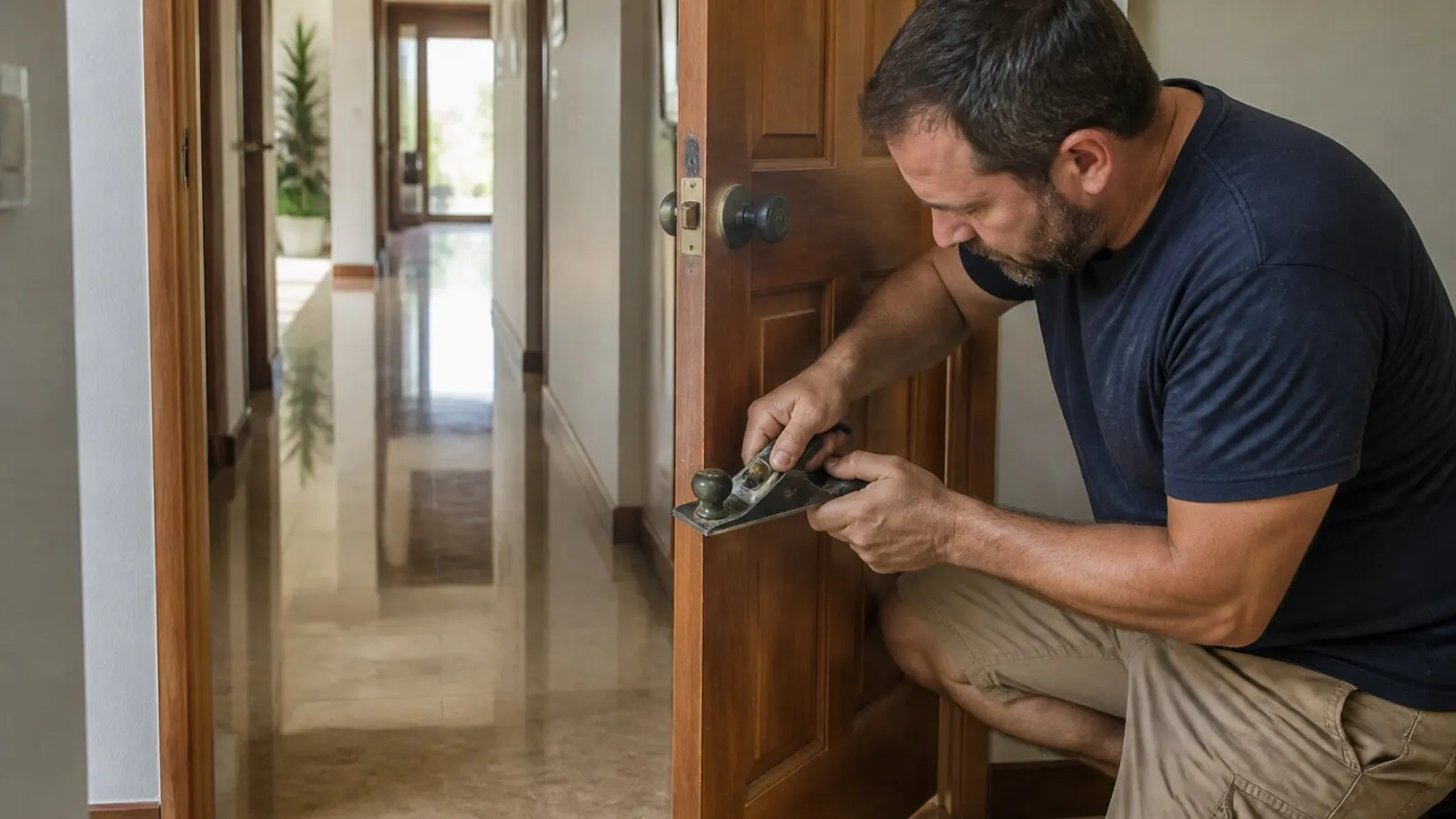
This is the most common call we take in Miami, and the diagnosis is almost always the same. The slab itself moves very little; the frame around it moves a great deal. Humidity swells the jamb legs, the head sags a fraction, the house settles another hair, and the clearance that was comfortable in February disappears in July. Run your eye down the gap between the door and the frame — if it is tight at the top of the latch side and open at the bottom, the door has dropped on its hinges, and the cure is at the hinge, not the edge of the slab. Planing the door is the shortcut that feels like a fix and is not one: come December the frame shrinks back and now you own a door with a permanent draught down one side.
Underneath most of these calls is a handful of hinge screws that have given up. The screws that came with the door are short, and in a jamb softened by years of Miami damp they eventually stop biting and start turning in a hole of their own making. Filler and a longer dab of glue buy a season. What actually holds is a longer screw that passes through the jamb and lands in the structural framing behind it, which pulls the whole frame back square and lifts the slab off the threshold at the same time. That one correction closes more Miami doors than any other thing we do, and it is the reason we ask for a photograph of the gap before we quote anything.
Thresholds, water and the damage nobody in Miami can see
The threshold is the part of a Miami entry door that fails first and announces it last. Rain here does not fall politely downward — it is driven sideways at the bottom of the door, and on a slab-on-grade house the water that gets past the sweep has nowhere to drain. It sits in the joint between the sill and the slab, and it works upward into the end grain of the jamb legs where they land. By the time a homeowner notices anything, the sweep is flattened, the sill flexes underfoot, and the paint at the bottom corner of the frame has begun to blister. Everything interesting is happening underneath the seal, which is exactly where nobody looks.
So we look there. The sweep and the sill plate come up, the jamb ends are probed, and the finding goes to you in plain language: sound and simply worn, or soft and no longer carrying the frame. A worn threshold and a tired weather seal are a straightforward morning's work, and in this climate the seal is earning its keep against driven rain and against the air conditioning you are paying to keep inside — the cold-weather argument for weatherstripping that people quote from up north is beside the point in Miami. If the jamb legs have gone punky where they meet the sill, we say that too, and that is usually the moment the conversation turns into a full opening and a permit, which is not a conversation we run away from.
Downtown Miami towers and the door that is not entirely yours
In 33128 and 33132 most homes sit several floors up around the Government Center, the Miami River and Biscayne Boulevard, and the entry door there is a different legal animal. A corridor door in a residential tower is very often fire-rated, and the label on the hinge edge is not decoration — it is what the door's rating rests on. It cannot be cut down, drilled through for a vanity handle set, or dressed with a decorative panel, and the closer on it is meant to be working, not disconnected because it slams. In most buildings that door is also association property rather than yours. When a resident calls us to change one, our first move is to read the declaration or ring management, because the wrong answer there costs a resident far more than the door did.
Inside the unit, the rules relax and the work is ordinary: bedroom and bathroom doors that catch on a high spot, closet doors off their track, latches that will not hold. The building still shapes the visit. Downtown management will normally want a vendor insurance certificate lodged in advance, a booked service-elevator window and work confined to approved hours, and the front desk logs the crew in and out. Give us the management contact when you book and that paperwork goes ahead of us, so nobody is standing at the loading dock with a toolbox and no lift. In the investor-owned units that cycle through tenants, the request is usually a turnover list rather than one door, and we would rather see the whole list at once than come back three times.
Neighborhoods and ZIP codes we cover in Miami
- Little Havana West (33125)
- Flagami & Airport District (33126)
- Wynwood & Little Haiti South (33127)
- Downtown Miami West (33128)
- Downtown Miami & Port (33132)
- Little Havana (33135)
- Health District & Overtown (33136)
- Allapattah (33142)
- Coral Way & Shenandoah (33145)
- Westchester & Glenvar Heights (33155)
- Olympia Heights & West Westchester (33165)
- Tamiami (33175)
- West Little River (33168)
- Westview (33167)
Door Repair & Installation in Miami — questions we get asked
What does door repair cost in Miami, and how do you work out the quote?
We do not publish a figure, because the same complaint has four different cures and they are not the same amount of work. The quote is free and written, and it follows four findings: where the door is binding, whether the hinges and their screws still have anything to hold, what condition the threshold and seal are in, and whether the hardware is worth keeping. Text pictures of the closed door, the gap on the latch side and the bottom of the frame to (786) 788-8714 and most answers go back the same day we see them.
Who actually turns up at my Miami house, and can I check them?
A crew member of ours, not a subcontractor we met that morning. The company carries insurance — ask and the certificate comes to you by text or email before the visit rather than after it. You will know who is coming and roughly when, and if the person at your door is not who we told you to expect, call the number on this page and do not let them in.
My Miami condo association says the entry door belongs to the building. Is that true?
Very often it is, and it is worth establishing before you buy anything. In most Miami condominium declarations the corridor door, its frame and its rating are common element, which means the association decides what is fitted, what colour it is, and who pays. Interior doors inside your unit are almost always yours. We are happy to read the relevant page of your documents, and if the association has a preferred process we follow it. Paperwork ahead of the visit — certificate of insurance, elevator booking, approved hours — is routine for us in the downtown buildings.
Is my Miami door worth repairing, or am I throwing money at it?
Ask three questions about the slab itself. Is it solid, is it straight, and is it dry at the bottom? A solid door that is sticking, sagging, draughty or missing hardware is a repair, and usually a short one. A slab that has delaminated, swollen and split along its bottom rail, or that has been kicked and repaired twice already, has reached the end and we will say so plainly. We would rather lose the repair than take payment for one that fails again by the next rainy season.
I rent in Miami. What will my landlord see when the work is done?
In most cases, a door that closes. Hinge and strike corrections, a new threshold and fresh weatherstripping leave no visible scar and no holes in the leaf. Where a lock or handle set is changed, the old one comes back to you in a bag so it can be refitted at the end of the tenancy. What we do ask is that the landlord or management company knows the work is happening — entry doors, locks and frames usually sit on the landlord's side of a Florida lease, and we would rather get that in writing beforehand than have you argue about it at move-out.
Do I need a City of Miami permit for work on my door?
It depends on which side of the line your address falls, and Miami is a patchwork. Little Havana, Allapattah and downtown are City of Miami; Westchester, Olympia Heights, Tamiami and Westview are unincorporated Miami-Dade and run through the county. For adjustments, hinge and strike work, threshold repair, weatherstripping and hardware, neither one is asking for a permit. Replacing an exterior door or changing the size of an opening is a different matter — in this county that means impact-rated product and an inspection, and it belongs to a licensed contractor rather than to us.
Why does my door stick more in the summer?
Wood doors and frames absorb humidity and swell during Miami's rainy season, causing sticking that often eases up in drier months. We plane or adjust the door so it clears the frame year-round instead of only fixing it temporarily.
Can you fix a door that won't latch?
Yes — usually a misaligned strike plate or a settling frame. We adjust the plate position or the hinges so the latch catches cleanly again.
Other work we do in Miami
- Ceiling Fan Installation & Repair in Miami
- Drywall Repair in Miami
- Faucet Installation & Repair in Miami
- Furniture Assembly in Miami
- Garbage Disposal Installation & Repair in Miami
- Light Fixture Installation in Miami
- Interior & Exterior Painting in Miami
- Picture & Mirror Hanging in Miami
- Shelf Installation in Miami
- Toilet Installation & Repair in Miami
- TV Mounting in Miami
Need door repair & installation in Miami?
Send photographs of the job to (786) 788-8714 and a written quote comes back naming the scope and the materials. The quote costs nothing, and nothing reaches the invoice that was not on it.