Blog › August 7, 2026 · 5 min read
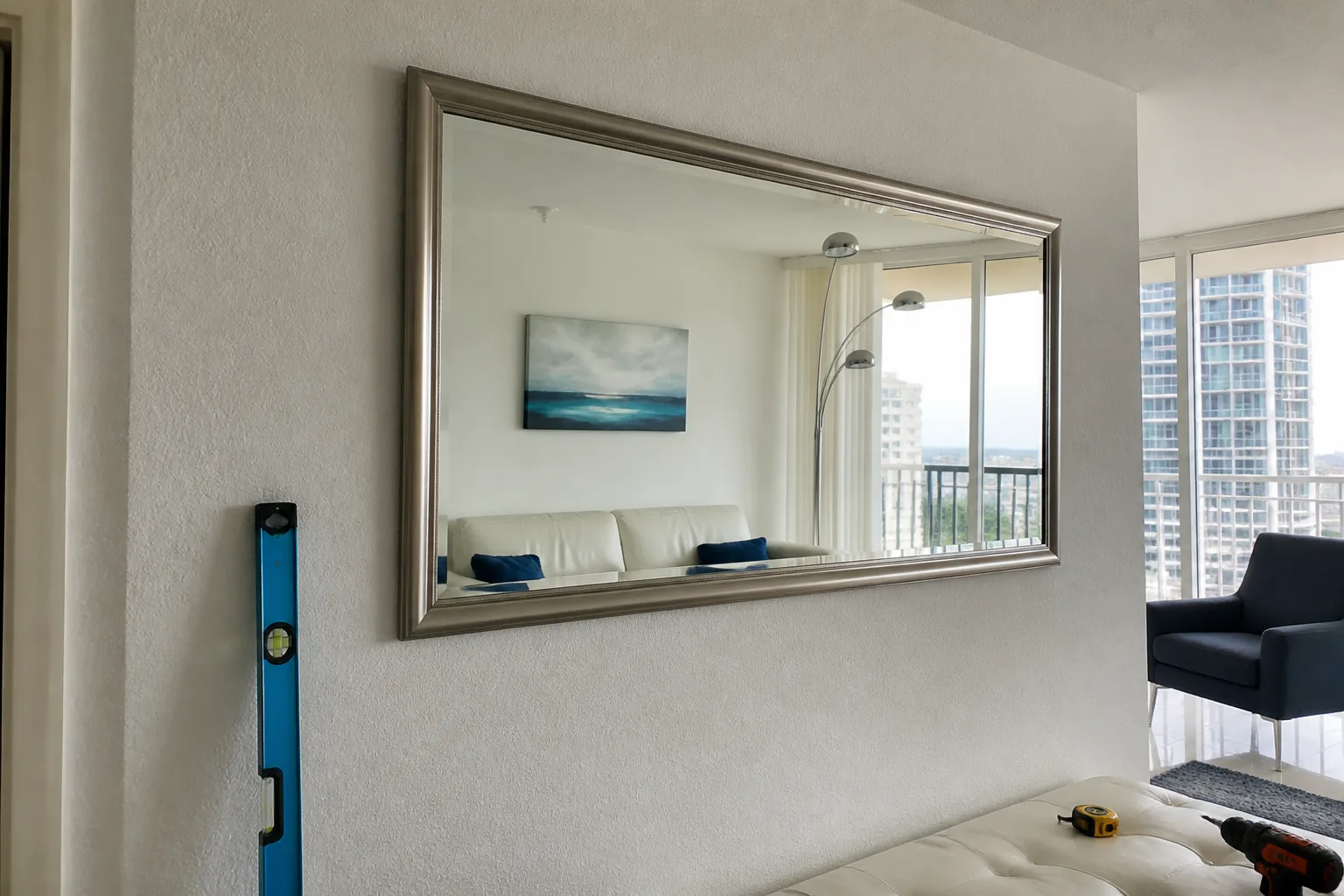
That oversized mirror or gallery-worthy art piece can transform a room, but hung wrong, it can also crack your drywall or crash off the wall in the middle of the night. Here's how to figure out what's behind your wall, pick the right hardware for the weight you're dealing with, and know when a heavy mirror is worth hiring out instead of guessing.
Key takeaways
- Match your anchor to actual weight: plastic anchors top out around 25 lbs, toggle bolts and stud screws handle 40+ lbs
- Always identify wall type first — many Miami homes have drywall over furring strips backed by concrete block, not open wood studs
- Use two D-rings and two spread-out anchor points for anything over 25-30 lbs rather than one central hook
- Humidity and years of wall aging reduce anchor grip over time, so size up rather than cutting it close
- For mirrors over 50 lbs, concrete block walls, or gallery layouts, hiring it out avoids cracked glass and wall repairs
Why 'just use a nail' doesn't work for heavy pieces
A picture hook rated for 20-30 lbs is fine for a small framed print. But once you're dealing with a mirror in the 40-80+ lb range — which is common for anything larger than about 24x36 inches with real glass — the weak point stops being the hook and starts being the wall material itself.
Standard half-inch drywall has almost no shear strength on its own. A single anchor point in open drywall (no stud behind it) starts to pull loose anywhere in the 15-25 lb range depending on the anchor, and repeated vibration from foot traffic, door slams, or AC cycling can loosen it further over time. In Miami's humidity, drywall paper backing also softens slightly over years, which weakens anchor grip more than most homeowners expect.
Step 1: Find out what's actually behind the wall
Before buying hardware, figure out whether you're dealing with wood-framed drywall, drywall over concrete block (CBS) with furring strips — extremely common in Miami-Dade construction — or bare concrete block or poured concrete.
Use a stud finder to scan a 16-24 inch width of wall; studs are typically spaced 16 inches on center in wood framing. If the stud finder gives inconsistent readings or the wall feels unusually solid when you knock on it, you may be dealing with concrete block behind furring strips, which is a different hanging job entirely and requires masonry anchors, not standard stud screws.
A simple knock test helps too: a hollow, drum-like sound usually means open stud bay; a dull, solid thud often means block or a stud directly behind that spot.
- Wood stud finders work reliably on drywall over wood framing
- Magnetic stud finders can help locate screws in metal furring strips
- If in doubt, drill a small test hole in an inconspicuous spot and check what comes out on the bit
Step 2: Match the anchor to the weight and wall type
Hardware matters more than most people think. Here are realistic weight ranges for common anchors used in residential walls:
For anything over about 35-40 lbs, plan on either hitting a stud directly or using two toggle bolts spread across the width of the frame — this distributes load and adds a safety margin if one anchor point loosens over time.
- Plastic expansion anchors: roughly 10-25 lbs, drywall only
- Metal self-drilling anchors: roughly 25-30 lbs, drywall only
- Molly bolts: roughly 25-50 lbs depending on size
- Toggle bolts (wing-style): roughly 20-50 lbs per anchor — best option for heavy pieces in open drywall
- Wood screw directly into a stud: 40-100+ lbs, the strongest option when available
- Concrete/masonry anchors (Tapcon screws or sleeve anchors) for block walls: 50-100+ lbs, but require a hammer drill and masonry bit
Step 3: Hanging it correctly, start to finish
Once you know your wall type and have the right anchor, the process is straightforward but benefits from a second set of hands, especially for mirrors over 30 lbs and anything wider than 3 feet.
Check the back of the frame first. Heavier mirrors should have two D-rings rather than a single wire — a single wire concentrates all the weight on one point and stretches over time, letting the mirror tilt forward.
- Mark your desired height and center point with painter's tape rather than pencil, so mistakes are easy to fix
- Measure the distance between the two D-rings or hanging points on the frame and transfer that measurement to the wall level
- Locate studs where possible; if not, mark toggle bolt locations at least a few inches apart for stability
- Pre-drill pilot holes slightly smaller than your anchor or screw
- Have a helper hold the mirror while you confirm placement before fully securing — heavy glass is not forgiving of a second attempt
- Add a strip of museum putty or a rubber bumper at the bottom corners against the wall to prevent slow tilting and wall scuffing
Miami-specific considerations
Many South Florida homes, especially anything built from the 1960s onward, use concrete block (CBS) construction with drywall attached to furring strips rather than open wood stud framing. This means the 'stud' you're feeling for might actually be a thin wood or metal furring strip with block directly behind it — you can't always drive a long screw straight into solid wood the way you could in a wood-framed house up north.
Humidity swings during hurricane season also affect wall material over time. Drywall that's been through a few humid summers grips anchors slightly less firmly than it did when new, which is another reason to size up your anchor rating rather than cutting it close.
If you're hanging anything heavy in a room near sliding doors or windows that get pressure changes during storms, it's also worth confirming the piece is secured well enough that it won't come loose during high winds or a temporary pressure shift in the house.
When it's worth hiring it out
A lot of heavy mirror and art hanging is genuinely doable with the right hardware and a level. But there are situations where it's worth having a pro handle it rather than risk a cracked mirror, a wall repair, or a piece coming down.
Gold Hands Miami handles picture and mirror hanging as a routine service call — bringing the right stud-finding tools, masonry bits for concrete block, and a range of anchor hardware so the job gets sized correctly the first time, without drywall damage or repeat trips. Gold Hands is insured, so if anything unexpected comes up during the job, you're covered. For anything that turns out to need real structural anchoring into a wall system or involves running new electrical for a lit mirror, that gets referred to a licensed pro rather than handled as a handyman job. You can reach Gold Hands at (786) 788-8714, or see more detail on the {picture-and-mirror-hanging service page}.
- Mirrors or art over 50-60 lbs, especially full-length or floor mirrors
- Anything going into concrete block or a wall you're unsure about
- Multiple pieces that need to be leveled and spaced as a gallery wall
- Mirrors going above a mantel, headboard, or anywhere a fall could cause real damage or injury
- Anytime you've already had an anchor pull out of the wall once
Frequently Asked Questions
How much weight can drywall alone hold without hitting a stud?
With a single anchor and no stud, plan on 20-25 lbs as a practical ceiling using a quality metal anchor. Beyond that, use two anchors spread across the frame, or find a stud.
Do I need a hammer drill for concrete block walls?
Yes, for a proper masonry anchor like a Tapcon screw you need a hammer drill and a masonry bit sized to the anchor. A regular drill will struggle and can wear out quickly trying to bore into block or concrete.
Is it better to hang a mirror on wire or D-rings?
D-rings are better for anything over about 20-25 lbs. A single wire concentrates weight on one point and can stretch or slip over time, letting the mirror tilt forward or drop.
How do I know if I'm dealing with drywall over furring strips vs. solid wood studs?
A stud finder set to deep-scan mode can sometimes pick up furring strips, but the reliable way is a small test hole or asking about the home's construction era — most CBS homes in Miami-Dade built from the 1960s on use furring strips over block.
What's the biggest mistake people make hanging heavy mirrors?
Using a single small anchor rated for far less weight than the actual mirror, often because the anchor came in the mirror's hanging kit and wasn't upgraded for the wall type or piece weight.
Can Gold Hands hang a mirror that needs to go into concrete block?
Yes, that's a routine part of the picture and mirror hanging service, using masonry anchors sized for the piece. Jobs that involve running new wiring for a lit or heated mirror get referred to a licensed electrician.
Need a hand in Miami?
Gold Hands Miami — insured crews, free upfront quotes. Related: picture and mirror hanging.
Call (786) 788-8714